

Cracking Financial Models & Academic Writing Standards
The landscape of modern higher education has shifted dramatically over the last decade. Undergraduate students entering business schools, economics departments, or accounting programs quickly realize that a degree in these fields is no longer a one-dimensional pursuit. It is a rigorous, multi-disciplinary journey. To excel, you cannot simply be a “numbers person” or a “words person”, the contemporary academic ecosystem demands that you be both simultaneously.
For many undergraduates, the transition from high school to university-level commerce courses introduces a sharp double-edged sword. On one side, you are confronted with dense, highly analytical quantitative frameworks that require precision and mathematical logic. On the other side, you are expected to articulate the real-world implications of those numbers through sophisticated, flawlessly structured essays and research papers. This dual pressure creates a distinct academic bottleneck, where a student might perfectly calculate a company’s financial valuation but struggle immensely to defend their methodology in a formal written report.
The Quantitative Hurdle: Unpacking Financial Modeling
At the core of any advanced business or corporate finance module lies the financial model. Whether you are forecasting future revenue streams, building a discounted cash flow (DCF) model, or analyzing leveraged buyout scenarios, the technical learning curve is exceptionally steep. Undergraduates frequently find themselves overwhelmed by the sheer volume of variables involved, from calculating the weighted average cost of capital (WACC) to adjusting for macroeconomic inflation rates.
A single misplaced formula or an incorrect assumption in a spreadsheet can collapse an entire projection, leading to flawed conclusions. This mathematical rigidity leaves very little room for error, which is why students often spend dozens of hours troubleshooting a single worksheet. When navigating these intricate numerical challenges under tight university deadlines, seeking specialized finance homework help can provide the clarity needed to break down complex formulas, decode balance sheets, and master the practical application of quantitative theories before exam season arrives.
[ Raw Financial Data ]
│
▼
[ Technical Processing ]
(Formulas, WACC, DCF Calculations)
│
▼
[ Academic Communication ]
(Translating data into structured arguments)
The difficulty is that universities rarely teach financial modeling in a vacuum. Professors do not just look at your final percentage or net present value output; they evaluate the strategic logic behind your financial assumptions. You must be able to justify why you selected a specific growth rate or why you categorized certain operational expenses a particular way. This means your mathematical output is only as good as the narrative you build around it.
The Qualitative Challenge: Translating Data into Written Arguments
Once the numerical calculations are complete, the second phase of the challenge begins: academic writing. For students who naturally excel at mathematics and statistical logic, shifting gears to write a 3,000-word corporate governance essay or a market analysis report can feel like learning a completely foreign language.
Academic writing at the undergraduate level comes with strict, non-negotiable standards that directly impact your final GPA:
- Evidence-Based Argumentation: You cannot simply state an opinion; every claim must be backed by peer-reviewed journals, financial histories, or credible market databases.
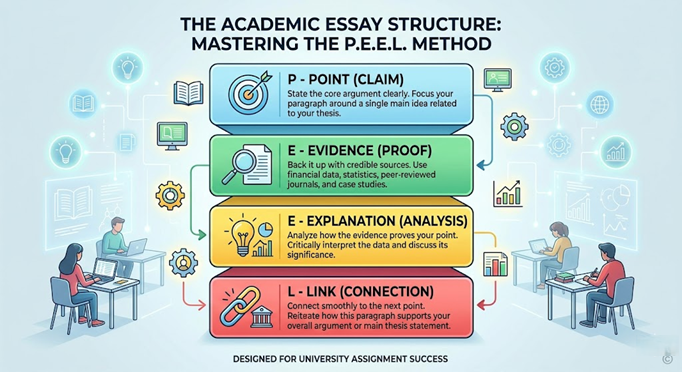
- Structural Logic: Paragraphs must flow seamlessly using frameworks like PEEL (Point, Evidence, Explanation, Link) to ensure the reader can follow your analytical journey.
- Formal Vocabulary and Tone: Content must remain completely objective, analytical, and devoid of casual or conversational language.
- Flawless Referencing Styles: Mastering Harvard, APA, or Oxford citation formats to ensure academic integrity and avoid unintentional plagiarism flags.
When a student struggles to bridge this gap, the quality of their hard work can get lost in poor formatting or weak essay construction. This specific pressure is a primary reason why many undergraduates turn to MyAssignmentHelp for comprehensive assignment services in the UK, ensuring that their qualitative arguments match the rigorous structural requirements of domestic universities. Relying on professional guidance helps students learn how to structure complex literature reviews, clarify abstract business theories, and format their reference lists strictly according to institutional rubrics.
Striking a Balance: A Comparative Look at Academic Requirements
To better understand how to allocate your study time and energy, it helps to compare the distinct demands of the quantitative and qualitative sides of your coursework. Both require deep focus, but they engage completely different cognitive skill sets.
| Core Dimension | Quantitative Assignments (e.g., Financial Modeling) | Qualitative Assignments (e.g., Business Essays) |
| Primary Skill Needed | Mathematical logic, data manipulation, formula application | Critical thinking, structural synthesis, persuasive writing |
| Common Bottlenecks | Broken Excel formulas, circular references, miscalculating risk | Weak thesis statements, poor paragraph flow, improper referencing |
| Evaluation Criteria | Numerical accuracy, logical assumptions, model integrity | Analytical depth, clarity of expression, adherence to rubrics |
| Ideal Approach | Step-by-step troubleshooting, iterative testing of data | Outline creation, multi-stage drafting, rigorous proofreading |
Recognizing these differences allows you to approach your weekly study routine more strategically, rather than treating every assignment with the exact same study habits.
Actionable Strategies for Undergraduate Success
Managing both sides of this academic coin requires a deliberate framework. You cannot rely on last-minute cramming when you have to balance data sheets with long-form writing.
1. Build a Structural Blueprint First
Never start typing an essay or opening an Excel sheet without a plan. For models, write down your inputs, formulas, and expected outputs on paper first. For essays, draft a detailed outline detailing exactly what each paragraph will argue. This keeps you from getting lost halfway through your project.
2. Isolate Your Study Zones
Because quantitative and qualitative tasks use different parts of your brain, avoid multitasking between them. Dedicate specific days or study sessions entirely to working on your spreadsheets, and separate blocks of time for reading literature and writing drafts. This minimizes cognitive fatigue and keeps your focus sharp.
[ Spreadsheets & Formulas ] ──( Separate Study Blocks )──► [ Reading & Essay Drafting ]
3. Edit for Clarity, Not Just Length
Many undergraduate students make the mistake of trying to sound overly complex in their writing, using bloated sentences that hide their actual point. The best academic writing is simple, direct, and clear. Read your sentences out loud; if a sentence takes more than two breaths to finish, it is too long and needs to be broken down.
Frequently Asked Questions
Q.1 Why do finance students need to be good at academic writing?
Ans: In the professional corporate world, financial analysts do not just pass raw spreadsheets to executives. They must write concise executive summaries, investment briefs, and market reports. Developing strong academic writing skills at the university level ensures you can communicate complex financial insights clearly to stakeholders who may not have a technical background.
Q.2 How do I fix a financial model that keeps returning errors?
Ans: Start by isolating your variables. Check your absolute and relative cell references to ensure your formulas are pulling data from the correct fields. Break down long, nested formulas into smaller, individual steps across separate columns to easily identify exactly where the calculation is breaking down.
Q.3 What is the most effective way to avoid plagiarism in business essays?
Ans: The most reliable method is to paraphrase ideas completely in your own words rather than just swapping out a few synonyms. Read the source material, close the tab, write down the core concept from memory, and then immediately append the correct in-text citation (e.g., Harvard or APA) to credit the original author.
Q.4 How can I better manage my time when handling multiple heavy modules?
Ans: Utilize time-blocking techniques and prioritize tasks based on their grade weight and difficulty. Spend your peak energy hours on highly complex tasks, like building financial models or drafting core essay arguments—and leave more administrative tasks, like gathering references or formatting bibliographies, for later in the day when your energy naturally dips.
About The Author
As a senior academic consultant at MyAssignmentHelp, I specialize in helping undergraduate students bridge the gap between complex quantitative analysis and high-level academic writing. With over a decade of experience guiding business, economics, and finance majors through rigorous university curricula, I focus on turning dense, technical data into clear, persuasive, and perfectly structured research papers.
MORE READ: How Sosoactive Is Shaping Modern Internet Culture?